Desktop development services
Desktop applications for Windows, macOS and Linux, built with Electron so they share code and design with your web product. They handle the work that only a desktop application can, including local files, hardware and offline use.
Our desktop development expertise
Software that has to live on the machine, and the parts of it that are hard to get right.
Custom desktop applications
Heavy files, hardware, offline work, long-running tasks, or a workflow that a browser tab cannot hold. We build these applications for the people who use them all day, on the operating systems they actually run.Web and desktop from one codebase
The same TypeScript and React that runs your web product, packaged with Electron for Windows, macOS and Linux, so a feature built once ships everywhere and the two products never drift apart.Local data and offline work
Data is stored on the machine, changes are queued without a connection, and sync with conflict handling runs when the connection returns.Files, hardware and the system
Large local files, scanners and other devices, the file system and the operating system’s own dialogs and notifications, reached through Electron’s native layer without slowing the interface.Installers and releases
Installers for the three platforms as part of every release, built and tested in the same pipeline as the rest of the product.
How we build desktop apps
Electron lets a desktop application share its code and its design with the web product, so a feature built once ships everywhere, and the desktop gets the same tooling, testing and release practices as the web.
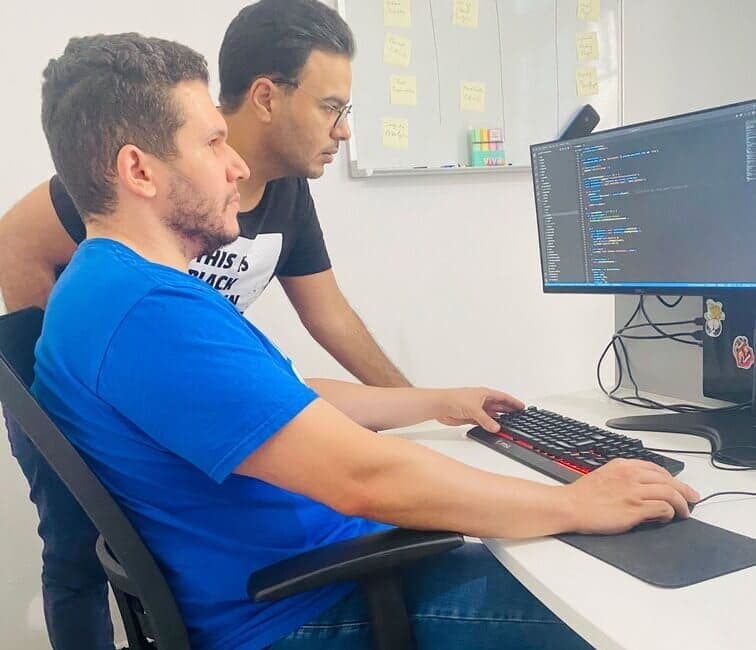
Engineers work with AI coding assistants every day, a second engineer reviews every change, automated tests and CI run on every change, and the application is run on each operating system before it ships.
Engineering standards
The same rules on every project, whatever its size.
TypeScript everywhere
Front end, back end and mobile in one typed language, so a whole class of mistakes is caught before users see it and the next engineer can read the codebase.Review on every change
A second engineer reviews every change before it ships, including code written with AI assistance.Automated tests and CI
Tests run on every change in a pipeline that blocks what fails. Nothing reaches production by hand.Staged environments and safe deploys
Separate development, staging and production environments, and deployments that do not take the product down.Security as routine
Nothing waits for a security phase at the end. Dependencies are kept current, secrets stay out of the code, access is granted on a need-to-have basis, and every project is checked against the OWASP list.Performance, measured
The screens and endpoints that matter get a target they have to meet, and we profile and test against it before a release rather than guess.Monitoring before launch
Error tracking and uptime monitoring in place before the first user arrives, with AI-assisted triage after.Documented and handed over
Decisions written down as they are made, instructions for running the product, and a clean handover if your own team takes over.
How you follow the build
Work runs in two-week sprints, and each one ends with a demo of working software. The backlog and the progress sit on a shared board you can open at any time, and the team is available to talk, review and decide throughout the sprint, not only at the demo.
Every change goes through review, automated tests and CI before it reaches staging, and nothing reaches production by hand. When something breaks after launch, monitoring tells us before your users do.
From idea to installer
Five steps, from the first conversation to the first install.
01Discover
We establish what the application has to do, who uses it all day, and why it belongs on the machine rather than in a browser tab.02Prototype
A high-fidelity interactive prototype is ready in days, so the people who will use the application every day can respond before anything is built.03Build
We build in TypeScript and React inside Electron, sharing code with the web product where there is one. Engineers use AI coding tools every day, and a second engineer reviews every change.04Test on each system
Automated tests and CI run on every change, and the application is run on Windows, macOS and Linux before it ships.05Release
We produce installers for the three platforms, with monitoring and error tracking in place before the first install.
What we build with
The stack is chosen for each application. These are the technologies we work with most.
- Desktop
- Electron, with TypeScript and React inside, for Windows, macOS and Linux.
- Backend
- Node.js on the server, with PostgreSQL first and MongoDB, Neo4j or Redis when the data has a different shape.
- Cloud
- AWS first, Cloudflare where it fits, and a plain server when that is the right size, with Docker-based deployments, separate development, staging and production environments, and CI/CD on every change.
“The team have a quick turnaround time and work independently. They are flexible in dealing with challenges or requirement changes. Moreover, they have prompt and professional communication, and their breadth of expertise stands out.”

- MVPs launched
- 36
- Startups coached
- 150+
- Mentorship programs
- 12
- Founded
- 2017
Frequently asked questions
Why Electron?
Electron lets a single codebase ship to Windows, macOS and Linux, in the same TypeScript and React that runs the web product, with the web’s tooling, testing and release practices behind it. For most products that share of code and design is worth more than the last percent of native polish. When it is not, WeaveLines says so.
What is a desktop application good for that a web app is not?
Desktop applications suit heavy local files, hardware such as scanners and lab instruments, long-running work that should not stop when a tab closes, and workflows people run all day where a window of their own serves better than a browser tab. WeaveLines builds those, and advises you when a web application would serve the same need with less to install.
Can the desktop app share code with our web app?
Yes, and that is usually the point. The interface, the business logic and the API calls can be the same code, packaged for the desktop with Electron. WeaveLines built Rushtera’s desktop manager that way, alongside its web platform.
Does it work offline?
It does when it needs to. Data is stored locally, changes are queued without a connection, and sync runs when the connection returns, with the conflict handling that sync requires. Which parts must work offline is a decision WeaveLines makes with you early, because it shapes the data model.
Are Electron apps slow?
They can be when built carelessly. Built with care, they are fast enough for the tools people use all day. WeaveLines keeps the heavy work off the interface, profiles the parts that matter against targets a release has to meet, and tests on real machines on each operating system.
Do you handle installers and releases?
Yes. Installers for Windows, macOS and Linux are part of the release, and every release goes through the same review, automated tests and CI as any other change WeaveLines ships.
How is desktop development priced?
A first version is usually a fixed-price project with an agreed scope, an agreed price and a launch date. Ongoing work runs on time and materials billed monthly, and a retainer covers fixes and improvements after launch. WeaveLines quotes after a short call about what the application has to do.
The application your users install
Tell us what it has to do and which machines it has to run on. A thirty-minute conversation is enough to establish what it would take.
Get in touch with us
Tell us about your product and your plans. We will come back with a clear view of what it would take and how we would approach it.
Our offices
- HeadquartersWeaveLines LLCrue Slah Eddine Bouchoucha2026 Sidi Bou SaidTunis, Tunisia
- Tunis OfficeWeaveLines LLC39 rue Ibn Khaldoun1002 Tunis, Tunisia