Web development services
Web applications that remain fast, secure and easy to change as the business grows. We build SaaS platforms, dashboards, APIs, integrations and real-time features in TypeScript on the React and Node.js ecosystems.
Our web development expertise
Seven kinds of work we are engaged for, and what each one involves.
SaaS platforms
Multi-user products with authentication, roles and permissions, subscriptions and billing, admin tooling and the audit trails a business needs. We begin with the simplest architecture that fits, with clear boundaries inside it, so the platform can be split up when growth demands it rather than before.Dashboards and data-heavy interfaces
Charts, large tables, filters, exports and live-updating data, designed around the decisions people make with them. Behind the screen, queries, caching and pagination are tuned so the dashboard stays fast as the data grows.APIs and integrations
REST and GraphQL APIs your product and your partners can rely on, together with webhooks and integrations with payments, CRMs, analytics, email and the other systems your operation runs on. Each one is built to withstand a failed request and to report when something fails.Real-time features
Live updates, chat, presence and collaboration over WebSockets, designed to degrade gracefully when a connection drops and to scale past a single server when the product requires it.Marketing sites
Fast, accessible, SEO-ready sites for the product, built with Astro or Next.js depending on how much of the site is content and how much is application.Legacy modernization
Software that has aged out of its stack is moved to a modern one without stopping the business. We assess it first, migrate it in steps, and test after every move.Cloud and DevOps
Infrastructure on AWS first, Cloudflare where it fits, or a plain server when that is the right size. We provide Docker-based deployments, separate development, staging and production environments, CI/CD on every change, monitoring and error tracking from the first release, and migrations between providers when a product outgrows where it started.
How we build
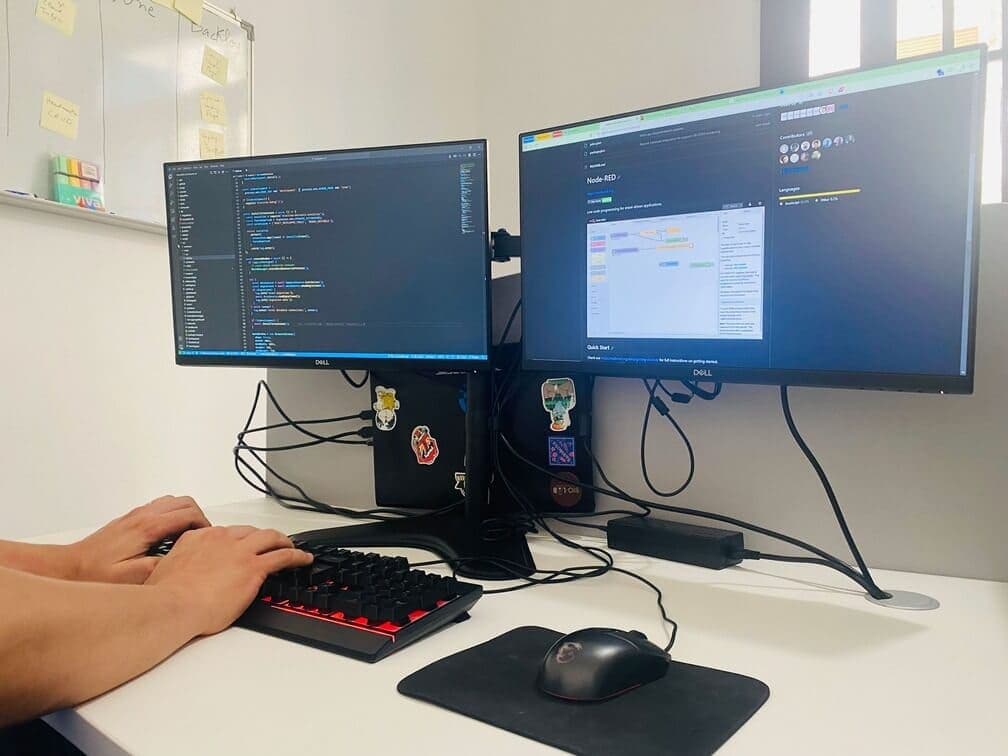
Engineers build in TypeScript on the React and Node.js ecosystems, with the framework chosen for the product. They work with AI coding assistants such as Claude Code, Cursor and Copilot every day, and a second engineer reviews every change before it ships.
Architecture follows the same rule on every project. We build the simplest shape that fits the product and split it up only when growth demands it, so scaling never means a rewrite. PostgreSQL comes first, with MongoDB, Neo4j or Redis when the data has a different shape. AWS comes first, with Cloudflare where it fits and a plain server when that is the right size, alongside Docker-based deployments, separate development, staging and production environments, and CI/CD on every change.
Engineering standards
The same rules on every project, whatever its size.
TypeScript everywhere
Front end, back end and mobile in one typed language, so a whole class of mistakes is caught before users see it and the next engineer can read the codebase.Review on every change
A second engineer reviews every change before it ships, including code written with AI assistance.Automated tests and CI
Tests run on every change in a pipeline that blocks what fails. Nothing reaches production by hand.Staged environments and safe deploys
Separate development, staging and production environments, and deployments that do not take the product down.Security as routine
Nothing waits for a security phase at the end. Dependencies are kept current, secrets stay out of the code, access is granted on a need-to-have basis, and every project is checked against the OWASP list.Performance, measured
The screens and endpoints that matter get a target they have to meet, and we profile and test against it before a release rather than guess.Monitoring before launch
Error tracking and uptime monitoring in place before the first user arrives, with AI-assisted triage after.Documented and handed over
Decisions written down as they are made, instructions for running the product, and a clean handover if your own team takes over.
How you follow the build
Work runs in two-week sprints, and each one ends with a demo of working software. The backlog and the progress sit on a shared board you can open at any time, and the team is available to talk, review and decide throughout the sprint, not only at the demo.
Every change goes through review, automated tests and CI before it reaches staging, and nothing reaches production by hand. When something breaks after launch, monitoring tells us before your users do.
Legacy modernization, step by step
Old software rarely fails all at once. It becomes slower to change until nobody wants to touch it. We move it to a modern stack in steps, so the business keeps running while the foundations are replaced.
- Assess
- We establish what the software does, what it runs on, and which parts are worth keeping.
- Plan
- We set the order of the moves, guided by what matters most to the business and what is riskiest to leave.
- Migrate
- We move one piece at a time to a stack the product can grow in.
- Integrate
- We connect the new pieces to the systems that stay, so nothing falls between the two.
- Test
- We test after every move, with automated tests and CI in place by the end, so the next change is straightforward.
What we build with
The stack is chosen for each product. These are the technologies we work with most.
- Front end
- TypeScript and React, with TanStack, Next.js or Astro depending on the product.
- Backend
- Node.js on the server, with PostgreSQL first and MongoDB, Neo4j or Redis when the data has a different shape.
- Cloud
- AWS first, Cloudflare where it fits, and a plain server when that is the right size, with Docker-based deployments, separate development, staging and production environments, and CI/CD on every change.
- AI features
- Claude, GPT, Gemini or open models, chosen per use case.
“They are excellent in every way. We required complete re-engineering, re-design and redevelopment of our software platform and product including cloud and web deployment and ongoing management of the platform.”

- MVPs launched
- 36
- Startups coached
- 150+
- Mentorship programs
- 12
- Founded
- 2017
Frequently asked questions
What kind of web applications do you build?
WeaveLines builds SaaS platforms with authentication, roles, subscriptions and admin tooling, along with dashboards and data-heavy interfaces. We deliver the APIs and integrations that connect a product to payments, CRMs, analytics and the systems a business already runs on, as well as real-time features such as live updates, chat and collaboration. We also build the marketing site that presents the product and modernize software that has aged out of its stack. All of this work is done in TypeScript on the React and Node.js ecosystems.
Which framework do you use?
We work in TypeScript and React and choose the framework for each project. TanStack serves application-heavy products where most of the work happens after sign-in, Next.js is chosen when it fits, and Astro serves content-heavy sites. Node.js runs behind them. PostgreSQL is our first choice, with MongoDB, Neo4j or Redis when the data has a different shape. We favor AWS, use Cloudflare where it fits, and run a plain server when that is the right size. WeaveLines selects the stack each product will grow in and builds accordingly.
How do you keep a web application fast as it grows?
We keep it fast by measuring it. The screens and endpoints that matter receive performance budgets that every release has to meet, and we profile and load-test against them rather than estimate. On the back end that means query tuning, caching and pagination designed for ten times the data. On the front end it means code splitting and rendering choices made per page. Monitoring after launch tells WeaveLines when a number moves before users notice.
How do you handle security?
We treat security as routine practice rather than as a phase at the end. Every change is reviewed by a second engineer. Dependencies are kept up to date, secrets stay out of the code, and access to accounts and data follows least privilege. Authentication, authorization and input handling follow OWASP guidance, and staged environments mean nothing is tested in production. WeaveLines builds security into the way the product is made rather than into a checklist afterwards.
How do you decide the architecture?
We start with the simplest shape that fits the product, a single well-structured application with clear boundaries inside it, which is what most products are fastest to build and easiest to run in. Separate services or serverless functions come in when load, team size or a specific workload calls for them, and the boundaries drawn early make that split a step rather than a rewrite. WeaveLines records each decision as it is made, so the reasoning remains available as the product grows.
How do you make integrations reliable?
We design integrations on the assumption that the other side will fail at times. Calls are retried with backoff, operations are idempotent so a repeated request never duplicates a payment or an order, and every exchange is logged so a failure is visible and recoverable rather than silent. Webhooks are verified and processed the same way. WeaveLines builds integrations to remain dependable when the service at the other end is not.
Do you handle infrastructure and DevOps?
Yes. WeaveLines sets up and runs the infrastructure the product needs. We favor AWS, use Cloudflare where it fits, or run a plain server when that is the right size, with Docker-based deployments, separate development, staging and production environments, CI/CD on every change, and monitoring and error tracking from the first release. When a product outgrows where it started, we migrate it. Rushtera moved between cloud providers with WeaveLines without a gap.
Can you take over an existing codebase?
Yes. WeaveLines begins with a short review of the code, the infrastructure and how the product is used, gives you a plain account of what holds up and what does not, and plans the shortest route to the next release. A rewrite is the last resort rather than the first suggestion.
How does legacy modernization work?
It proceeds in steps, without stopping the business. We assess what exists, plan the migration around the parts that matter most, move them to a modern stack one at a time, connect the new pieces to the systems that stay, and test after every move. Rushtera came to WeaveLines with a PHP platform that needed re-engineering and left with a modern one on a new cloud setup.
How will I follow the project?
Work runs in two-week sprints, each ending with a demonstration of working software. The backlog and the progress are on a shared board you can open at any time, and the WeaveLines team is available to talk, review and decide throughout the engagement, not only at the demo. Every change goes through review, automated tests and CI before it reaches staging.
Do you also design what you build?
Yes. Design and engineering happen in the same place at WeaveLines. We produce a high-fidelity prototype in days, then build the interface and the design system in Figma with the same engineers. If you already have a designer or a design system, we build from it.
How is web development priced?
A scoped web application, dashboard or feature is usually a fixed-price project with an agreed launch date. Ongoing product work runs on time and materials billed monthly, and a retainer covers support, fixes and steady improvement after launch. WeaveLines quotes after a short call about what you are building.
From the blog
What actually gets faster with AI-assisted development, and what does not
AI coding assistants make some engineering work dramatically faster and leave the rest exactly as slow. This article covers the numbers from studies and agencies, what we see on our own projects, and the practices that decide whether the speed is real.Read moreCloud costs for a startup on AWS, Cloudflare or a plain server, and how to keep the bill in check
This article explains where a startup’s cloud bill comes from, what AWS, Cloudflare and a plain server each cost in money and in attention, and the habits that keep infrastructure spending in proportion to the product.Read moreWhen a startup should build a design system, and what it saves later
A design system is the set of tokens, components and rules that keeps a product consistent as it grows. For a startup the question is not whether to have one but when. This article covers what a design system is, what it saves, when it is too early, and how to start small.Read more
Built to grow with the business
Tell us what the product has to do and what it runs on today. A thirty-minute conversation is enough to establish what it would take.
Get in touch with us
Tell us about your product and your plans. We will come back with a clear view of what it would take and how we would approach it.
Our offices
- HeadquartersWeaveLines LLCrue Slah Eddine Bouchoucha2026 Sidi Bou SaidTunis, Tunisia
- Tunis OfficeWeaveLines LLC39 rue Ibn Khaldoun1002 Tunis, Tunisia